QUICK ANSWER: A tear down and rebuild in Northern Virginia costs roughly $10,000 to $25,000 for demolition plus $250 to $450 per square foot for the new home, putting most full projects between $900,000 and $2.5 million before land. The decision rule most builders use: if your land is worth more than half your total property value, or your renovation scope exceeds about 50% of the home’s value, rebuilding usually wins. Fairfax County requires a residential demolition permit through the PLUS portal, with utility disconnect confirmations and asbestos abatement before the permit is issued.
Let’s play a game. Drive through Vienna, McLean, Great Falls, or Arlington’s Lyon Village on a Saturday. Count the dumpsters. Count the excavators. Count the brand-new modern farmhouses standing where a 1962 split-level used to be.
Lost count? Same.
Something big is happening across Northern Virginia, and if you own an older home on a good lot, you are sitting right in the middle of it. The tear down and rebuild wave is real, it’s accelerating, and it has homeowners asking one very expensive question: do I renovate this house, or do I take the whole thing down and start over?
Here’s the honest answer, from people who actually swing hammers here. No press release. No fluff. Just the numbers, the county rules, and the decision framework that separates a brilliant tear down and rebuild from a very expensive regret. Grab a coffee. This one’s worth reading twice.
What a Tear Down and Rebuild in Northern Virginia Actually Means
Simple version: you demolish the existing house down to bare dirt, then build a brand-new custom home on the same lot you already own. You keep the address. You keep the school district. You keep the mature oak trees, the commute, and the neighbors you actually like. Everything else? Gone.
It’s different from a whole home renovation, where you keep the structure and reimagine it. It’s different from buying a teardown lot, where you purchase someone else’s tired house purely for the land underneath. If you’re weighing that route instead, our guide on teardown lot vs. vacant land for your Northern Virginia custom home breaks that comparison down properly.
This article is for a specific person: you already own the home. You love where you live. And you’re wondering if the smartest dollar is the one you spend on a bulldozer.
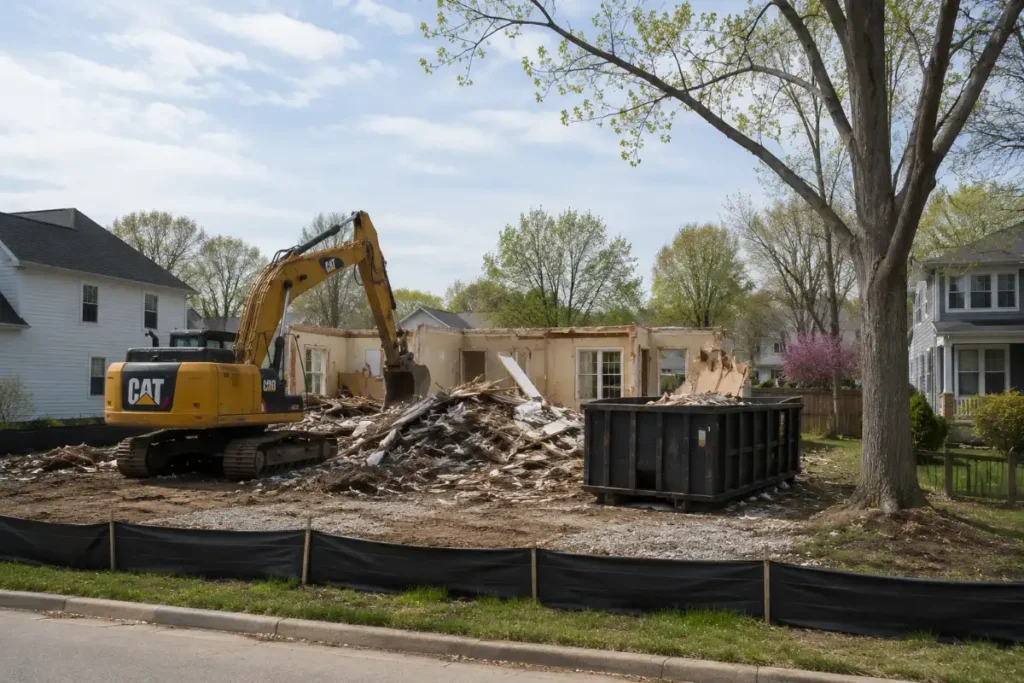
Why the Tear Down and Rebuild Trend Is Exploding Across NoVA
Three forces collided, and homeowners noticed.
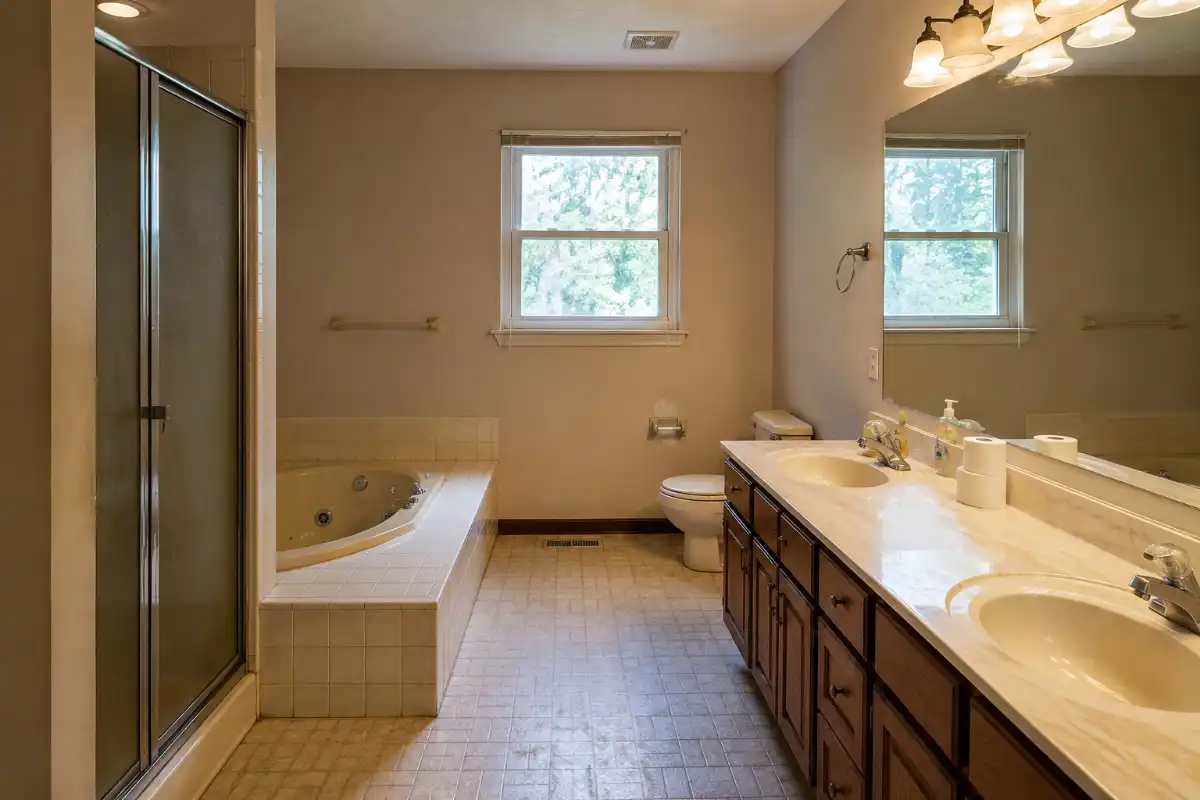
The housing stock got old. Huge swaths of Northern Virginia were built between 1950 and 1985. Those homes have chopped-up floor plans, 8-foot ceilings, knob-and-tube wiring, galvanized plumbing, and primary bathrooms roughly the size of a coat closet. Charming? Sometimes. Functional for how families live in 2026? Not really.
The land got expensive. In McLean, Great Falls, Vienna, and inner Arlington, the dirt is frequently worth more than the structure sitting on it. When your lot carries the value and the house is just a depreciating shell, the math starts whispering.
Nothing new is being built nearby. Established neighborhoods are full. There are no new lots. So if you want a modern home in a mature neighborhood with the trees and the schools already in place, a tear down and rebuild is often the only door left open.
Add it up and you get the pattern you’re seeing on every Saturday drive: families choosing to stay put and build up rather than move out and start over somewhere they like less.
Tear Down and Rebuild Cost in Northern Virginia: Real 2026 Numbers
Let’s talk money, because “it depends” has never funded a construction loan. A tear down and rebuild splits cleanly into two budgets. Keep them separate or you’ll fool yourself.
Part One: Demolition Cost
Residential demolition in Virginia runs roughly $5 to $12 per square foot of the old structure. For Northern Virginia specifically, expect the higher end thanks to DC-area labor, tight lot access, and stricter disposal rules.
| Demolition Line Item | Northern Virginia Cost (2026) |
|---|---|
| Standard house teardown (1,500 to 2,500 sq ft) | $12,000 to $25,000 |
| Home with full basement | Add $4,000 to $8,000 |
| Asbestos abatement (pre-1985 homes) | $3,000 to $15,000+ |
| Utility disconnects and sewer cap-off | $1,500 to $5,000 |
| Demolition permit and bond | $500 to $2,500 |
| Site clearing, grading, haul-off | $10,000 to $30,000 |
Most homeowners land in the $25,000 to $50,000 range once everything’s actually accounted for, not the tidy $15,000 the demo quote showed.
Part Two: The Rebuild
This is where the real money lives. Northern Virginia custom construction in 2026 runs about $250 to $450 per square foot for well-built homes with quality finishes, and $450 to $750+ per square foot for estate-grade work with custom millwork and premium systems.
| Home Size | Rebuild Cost (2026, construction only) |
|---|---|
| 2,500 sq ft | $625,000 to $1,125,000 |
| 3,500 sq ft | $875,000 to $1,575,000 |
| 5,000 sq ft | $1,250,000 to $2,250,000 |
| 5,000 sq ft estate-grade | $2,250,000 to $3,750,000+ |
Total tear down and rebuild in Northern Virginia: roughly $900,000 to $2.5 million for most projects, excluding land you already own. These are planning ranges, not quotes. An estimate without a site visit is fan fiction with a dollar sign.
Two line items nobody budgets for: site work and soft costs. Grading, stormwater management, driveway, tree protection, retaining walls, and utility runs routinely add $50,000 to $200,000 in NoVA. Architecture, engineering, surveys, and permits add another $40,000 to $120,000. Budget a 15 to 20 percent contingency and expect to use part of it. Older lots hide surprises the way older houses hide knob-and-tube.
When you’re ready to fund it, our construction financing resource walks through construction loans, HELOCs, and 203k options in plain English.
Tear Down and Rebuild vs. Renovate: The Decision Framework
Here’s the part most articles skip because it requires actual conviction. Use these five tests.
Test 1: The Land Value Ratio
Pull your county assessment and separate land value from improvement value. If land is worth more than 50 percent of total property value, a tear down and rebuild usually pencils out. In Great Falls, McLean, and Vienna, plenty of properties are sitting at 60 to 75 percent land value. That’s a flashing green light.
Test 2: The 50 Percent Renovation Rule
Price your dream renovation honestly. If the scope exceeds roughly half your home’s current value, you’re paying rebuild prices to live in an old shell. Once you’re replacing the systems, the roof, the windows, the walls, and the layout, you’ve functionally built a house without getting the benefits of building a house.
Test 3: The Structural Test
Some homes tell you the answer. Failing foundation, compromised framing, chronic water intrusion, or a slab that was poured wrong by an ambitious previous owner? No amount of gorgeous tile fixes that. Get a structural assessment before you commit either direction. It’s the cheapest money you’ll spend on this project.
Test 4: The Envelope Test
This one’s sneaky. Older homes were often built under zoning that no longer applies. A rebuild lets you use the full buildable envelope: current setbacks, current lot coverage, current height allowance. Building up on an old home can blow past height limits, while a clean rebuild can legally capture significantly more square footage. Sometimes you can’t get where you want to go by renovating, at any price.
Test 5: The Time Horizon Test
Staying 15+ years? A tear down and rebuild is a legacy investment. Moving in three? Renovate, sell, and let the next owner swing the wrecking ball.
Renovate instead when: the foundation and framing are sound, the floor plan can be reconfigured, you love the home’s character, and your budget sits under $750,000. Our full home renovation team handles exactly this transformation, and our full home renovation vs. buying a new house breakdown runs that comparison in detail. If you just need more room rather than a whole new home, a home addition or a second-story addition may get you there for a fraction of the cost.
Tear Down and Rebuild Permits: County-by-County in Northern Virginia
Every county plays by its own rulebook. Here’s what actually matters.
Fairfax County
Fairfax requires a Residential Demolition (DEMOR) permit for full or partial demolition, applied for through the PLUS portal (Planning and Land Use System). Before the demolition permit issues, you’ll need written confirmation of utility disconnects from every provider serving the property: Washington Gas, Dominion, Fairfax Water, and your sewer authority. If asbestos is present, a licensed Virginia abatement company must handle removal under a miscellaneous permit, and a plumbing permit is required for sewer cap-off on public sewer.
Your package gets reviewed by the Permit Application Center, Building Plan Review, Zoning, Wastewater, Health Department (if on well or septic), Fire Marshal, and Site Technician Review. Depending on land disturbance, a grading plan may be required. Vienna and Clifton residents need additional town approval. Minimum building permit fee starts at $108, with fees calculated by valuation, plus a 1 percent code academy surcharge.
City of Fairfax
Separate jurisdiction from the county, with its own process. Notably, a $1,000 bond must be secured before demolition can proceed, and a licensed Virginia asbestos removal company must perform any abatement.
Arlington, Alexandria, Falls Church
Independent permitting jurisdictions. Arlington and Alexandria infill lots are tightly constrained by lot coverage, setbacks, parking, stormwater, and design expectations. Teardown-rebuild hotspots include Lyon Village, Clarendon, Ashton Heights, Del Ray, Rosemont, and Beverley Hills. Expect neighborhood logistics to matter as much as engineering here.
Loudoun and Prince William
More room to work, larger lots, and generally faster processing. Loudoun tends to move quicker than Fairfax, though HOA-governed and rural policy areas carry stricter site plan rules. Prince William offers strong value in Gainesville, Manassas, Bristow, and Woodbridge.
Want the deeper walkthrough? Our building permit guide covers the process county by county.
This is general information, not legal advice. Confirm requirements with your locality before you build.
The Tear Down and Rebuild Timeline: What 18 Months Actually Looks Like
Nobody tells you this part, so we will. A tear down and rebuild in Northern Virginia is a 14 to 24 month project from first sketch to move-in day.
- Months 1 to 4: Feasibility, survey, architectural design, engineering.
- Months 4 to 8: Permit submission and review. This is where projects stall. Resubmissions restart the review clock.
- Month 8 to 9: Utility disconnects, abatement, demolition, site clearing.
- Months 9 to 20: Construction, inspections, finishes.
- Month 20+: Final inspection, certificate of occupancy, keys.
And yes, you need somewhere to live for all of it. Budget 12 to 18 months of rent into your real number. Most people forget this and then discover it in month seven, which is a terrible month for surprises.
Why AZA Builders Is the Right Partner for Your Tear Down and Rebuild
Here’s the honest pitch. A tear down and rebuild is the highest-stakes project a homeowner ever takes on. There is no undo button after demolition day. You want a team that tells you the truth in month one, not month twelve.
AZA Builders is a Class A licensed, veteran-owned design-build contractor headquartered at 14100 Sullyfield Cir Suite 300, Chantilly, VA 20151, serving McLean, Great Falls, Vienna, Fairfax, Arlington, Leesburg, Reston, Gainesville, Bristow, and Woodbridge. We run architecture, engineering, permitting, and construction under one roof, which means one accountable team instead of a finger-pointing relay race. Curious why that structure matters? Our design-build vs. general contractor comparison explains the difference in real dollars.
We build custom homes that are designed around how you actually live, not how a floor plan catalog says you should. Chef-grade kitchens. Finished basements that earn their square footage. Exterior renovations with real curb appeal. And outdoor living spaces with custom patios, outdoor kitchens, fire features, pergolas, and intentional landscaping that turn your backyard into the best room in the house. Because a rebuild isn’t finished when the roof goes on. It’s finished when the lawn is in, the grill is lit, and the whole property finally feels like yours.
Browse the project portfolio to see the craftsmanship, or raid our design ideas gallery if you’re still collecting inspiration. We start every project with a feasibility conversation, not a sales pitch. We’ll tell you if renovating is the smarter play. Sometimes it is, and you deserve to hear that before you write a check.
Frequently Asked Questions About Tear Down and Rebuild in Northern Virginia
How much does it cost to tear down and rebuild a house in Northern Virginia? Demolition runs $12,000 to $25,000 for a standard home, with total demo costs reaching $25,000 to $50,000 after abatement, utility disconnects, permits, and site work. The rebuild adds $250 to $450 per square foot for quality custom construction. Most complete projects land between $900,000 and $2.5 million, excluding land.
Is it cheaper to renovate or tear down and rebuild? Renovating is almost always cheaper when the foundation, framing, and major systems are sound. Rebuilding wins when land value exceeds roughly half the property value, when renovation scope passes about 50 percent of the home’s value, or when structural problems make renovation impractical.
Do I need a permit to tear down a house in Fairfax County? Yes. Fairfax County requires a Residential Demolition (DEMOR) permit applied for through the PLUS portal. You’ll need written utility disconnect confirmations, a plumbing permit for sewer cap-off on public sewer, and a miscellaneous permit for asbestos abatement if asbestos is present.
How long does a tear down and rebuild take in Northern Virginia? Plan for 14 to 24 months total: roughly 4 months for design, 4 months for permitting, 1 month for demolition and site prep, and 10 to 14 months for construction. Budget for temporary housing throughout.
Does a tear down and rebuild add value in Northern Virginia? In established neighborhoods where land carries most of the value and new construction is scarce, a rebuild typically delivers strong long-term appreciation and much broader buyer appeal than an aging home with a dated layout.
What are the hidden costs of a tear down and rebuild? The usual budget killers are asbestos abatement, site work and grading, utility extensions, stormwater engineering, tree preservation requirements, soft costs like engineering and surveys, and 12 to 18 months of temporary housing.
Ready to Find Out What Your Lot Can Really Do?
Here’s the truth: the homeowners winning at this in 2026 are not the ones with the biggest budgets. They’re the ones who ran the numbers honestly before falling in love with a floor plan. Your land value ratio, your structural condition, your buildable envelope, and your time horizon will tell you whether a tear down and rebuild in Northern Virginia is your best move or your most expensive detour. You just need someone to read those numbers with you.
That’s exactly where we start. Book your free consultation with AZA Builders and we’ll walk your lot, run the feasibility math, and give you a straight answer, even if that answer is “keep this house.” See us on Instagram & YouTube. Visit our Google Business Profile to see client reviews in Fairfax, Arlington, Leesburg, McLean, and beyond.
Schedule Your Free Consultation → or book an appointment online. Call (571) 393-2722. Your future home is already standing. It’s just wearing a 1968 disguise.